Manus AI
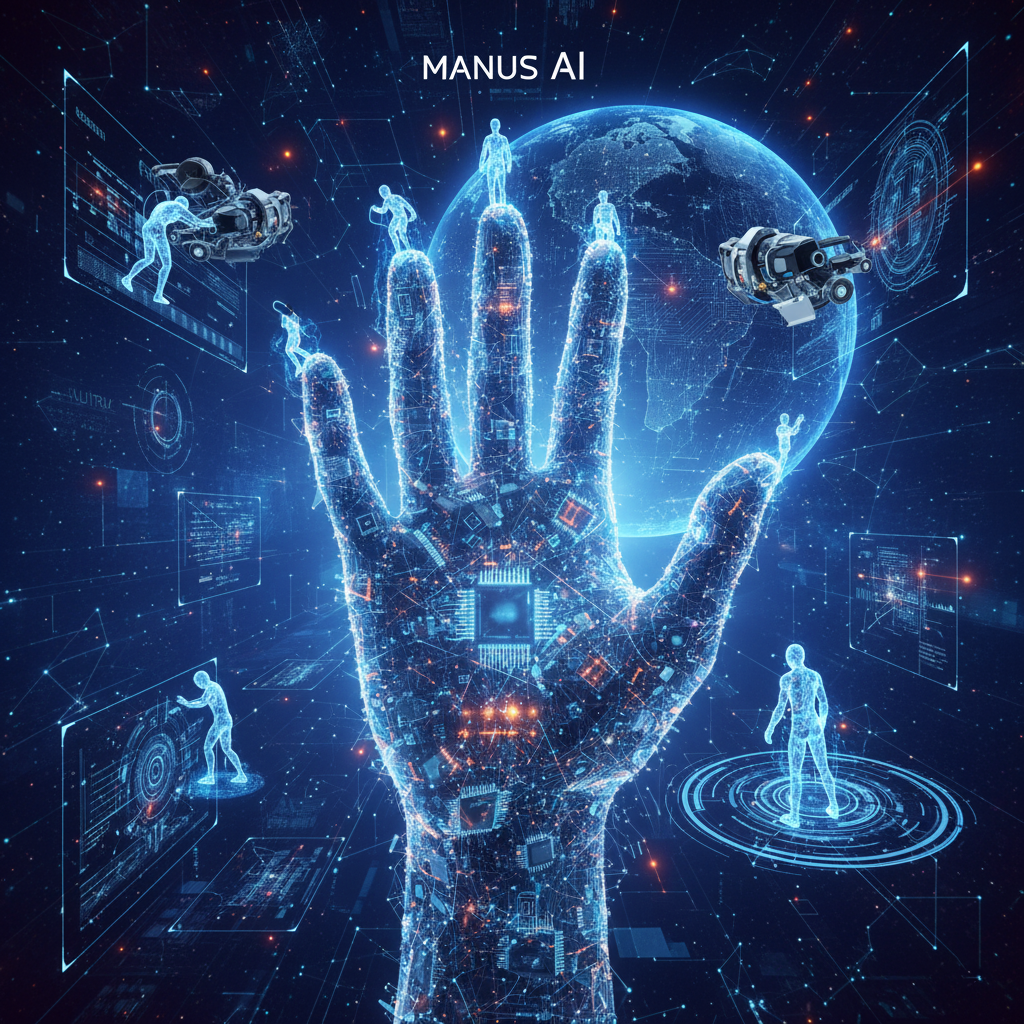
Launched in 2025, Manus AI represents a revolutionary milestone in the evolution of autonomous artificial intelligence. Unlike traditional AI assistants that merely respond to prompts, Manus can plan, reason, and execute complex operations without human intervention — a leap toward true machine autonomy.
Cognitive autonomy powered by Claude 3.7 Sonnet
Built on the powerful Claude 3.7 Sonnet model, Manus AI is designed to understand context, analyze data, and make strategic decisions to achieve defined objectives. It can develop end-to-end workflows, generate executable code, and optimize outcomes dynamically — all while adapting to new variables in real time.
This marks the dawn of executive artificial intelligence, where AI agents are not tools but collaborators capable of reshaping entire industries.
Core capabilities
- System navigation: accesses and manipulates web platforms or databases autonomously.
- Task decomposition: breaks down complex goals into manageable subtasks and executes them via generated scripts.
- Automated data handling: creates structured documents, reports, and databases.
- Scenario adaptation: applies reasoning to marketing, research, coding, or strategic planning.
- Custom reasoning depth: users can adjust its cognitive and operational intensity according to project needs.
Real-world applications
Manus AI is redefining productivity across various sectors:
- Healthcare: automating record management, diagnostic analysis, and patient monitoring.
- Research: processing experimental datasets to detect patterns or anomalies.
- Software development: generating, testing, and deploying code automatically.
- Business: performing analytical tasks, preparing reports, and supporting executive decision-making.
With its continuous learning engine, Manus evolves through use, enhancing performance and accuracy with every task cycle.
Human oversight and safety protocols
Despite its autonomy, Manus operates within strict ethical and security frameworks. Every autonomous action is logged, monitored, and auditable. Critical decisions require user validation, ensuring that automation never replaces accountability.
This hybrid approach balances freedom of action with human judgment, creating a reliable partnership between people and AI.
The future of integration
Upcoming updates promise a public API, voice command functionality, and compatibility with popular work ecosystems such as Slack, Notion, and Google Workspace. Open-source extensions will also allow developers to expand Manus’s abilities to new domains.
The new paradigm of AI collaboration
Manus AI marks the transition from passive intelligence to active collaboration. As organizations adopt autonomous agents, human creativity and strategic thinking will become even more valuable, while repetitive or complex tasks will be fully automated.
The era of intelligent agents is no longer a concept — it’s a reality. With Manus AI, we step into a future where machines don’t just follow instructions; they understand, decide, and act.