
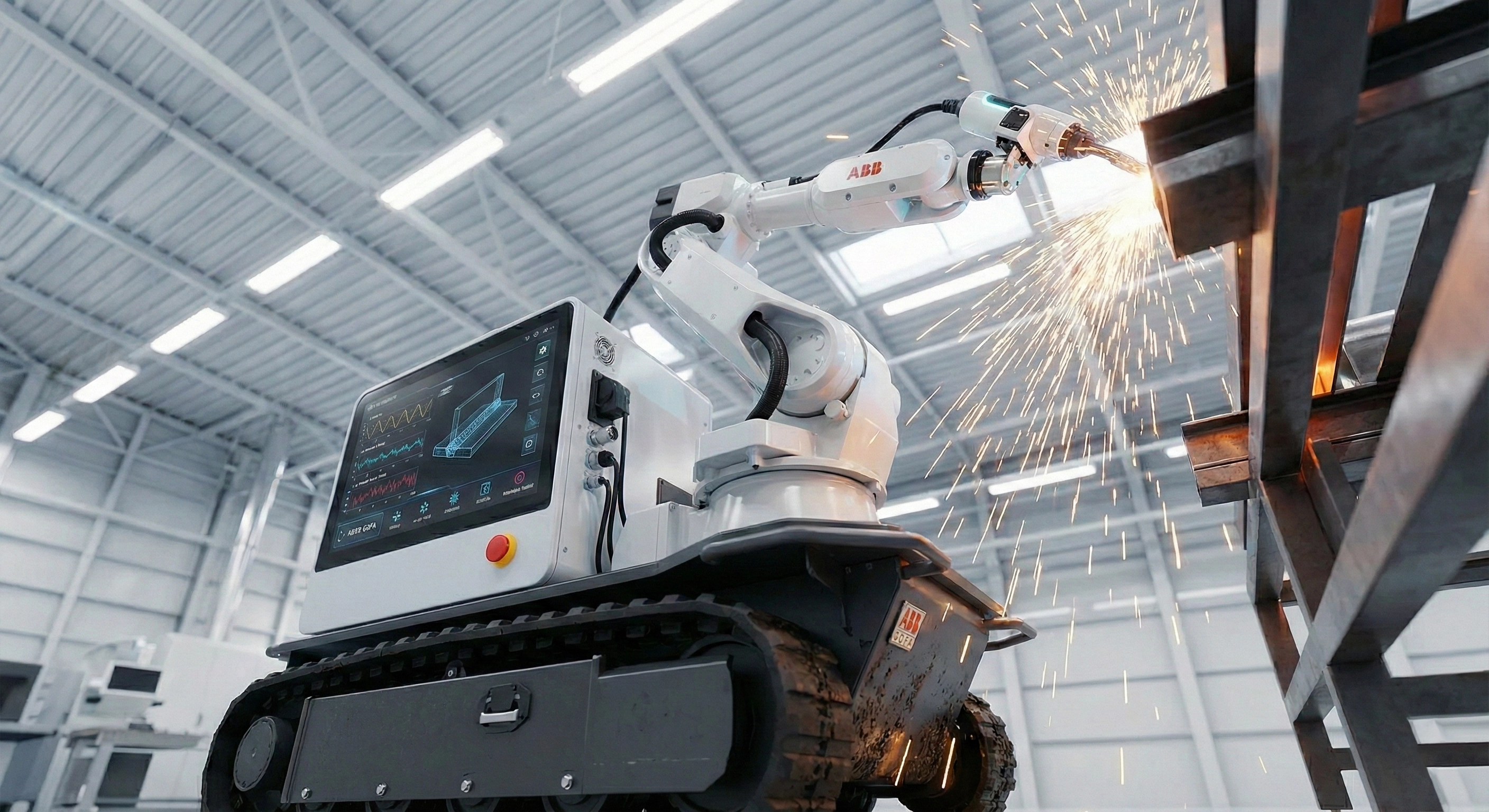
The rise of intelligent welding in modern manufacturing
Artificial intelligence has redefined the welding industry by transforming processes once dependent on manual adjustments and human supervision into fully automated, adaptive and predictive operations. In 2025, AI-powered welding robots are essential assets in industries such as automotive, aerospace, heavy machinery and energy infrastructure. Their ability to analyze data, learn patterns and adjust parameters in real time allows companies to achieve unmatched levels of precision and efficiency.
Below is a comprehensive analysis of the 15 most advanced AI welding robots shaping global manufacturing. Each represents a major technological milestone, offering competitive advantages such as predictive maintenance, structural precision, energy efficiency and operational safety.
1. RoboWeld X5: dynamic precision powered by adaptive learning
RoboWeld X5 can automatically modify amperage, speed and penetration depth based on real-time material conditions. By analyzing temperature, reflectivity and alloy properties, it ensures uniform bead formation while significantly reducing waste.
2. AutoArc Mobile 3000: autonomous welding for extreme environments
AutoArc Mobile 3000 excels in remote and hazardous locations. Through intelligent algorithms, it adjusts voltage, current and trajectory while navigating uneven surfaces, making it ideal for field repairs on pipelines and energy structures.
3. SmartWeld AI: self-calibration and advanced diagnostics
SmartWeld AI features continuous auto-calibration, alignment checking and predictive diagnostics. It synchronizes welding parameters with cloud analytics to detect anomalies before they disrupt production.
4. OmniWeld Pro: thermal-aware welding to prevent deformation
With infrared sensors feeding temperature data into its AI engine, OmniWeld Pro adjusts heat distribution to prevent deformation in critical components. It is widely used in aerospace and high-precision manufacturing.
5. ArcMover 5000: self-learning adaptation for diverse materials
ArcMover 5000 learns from each weld performed, storing parameters for future optimization. It adapts to variations in thickness, alloys and shapes, ensuring stable, clean and high-strength joints.
6. KUKA Weldbot Series: artificial vision for unmatched accuracy
KUKA’s Weldbot series integrates advanced machine vision with AI algorithms capable of identifying invisible edges and delivering tolerance levels up to ±0.2 mm, making it crucial for automotive production lines.
7. Fanuc ArcMax: deep learning for complex edge detection
ArcMax uses neural networks to analyze irregular edges and micro-defects, delivering smooth and consistent motion across any metallic surface. It is highly valued in automotive body manufacturing.
8. ABB GoFa™: collaborative arc welding powered by AI
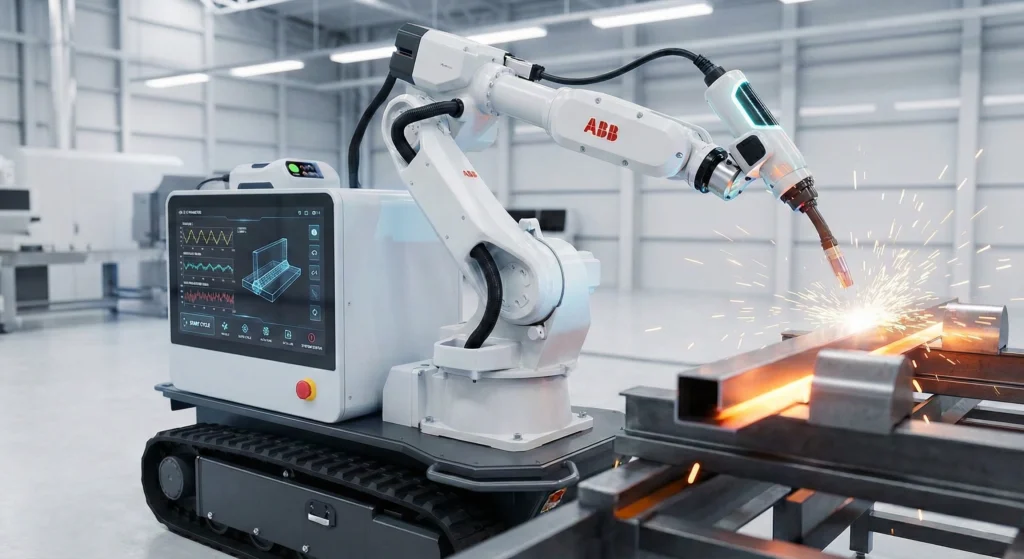
ABB GoFa™ automatically defines optimal paths and adjusts arc settings using AI. Its collaborative design ensures safe interaction with human operators in flexible production environments.
9. Path Robotics AI-Driven Welders: fully autonomous path generation
These robots require no manual programming. The AI analyzes the geometry, creates the trajectory and performs the weld with exceptional speed and adaptability.
10. Universal Robots UR Weld: flexible automation for small businesses
UR Weld cobots bring cost-effective automation to small manufacturers. Their AI-enabled configuration simplifies repetitive welding tasks while maintaining consistent quality.
11. Daihen AI Weld Systems: real-time monitoring for stable performance
Daihen systems use adaptive intelligence to stabilize the arc in variable conditions. Their real-time adjustments reduce defects and downtime, improving overall productivity.
12. Yaskawa Motoman Welding Robots: MIG/TIG intelligence with efficiency gains
Motoman robots integrate AI to optimize MIG and TIG welding, balancing energy efficiency with structural precision. They are widely adopted in infrastructure and transportation manufacturing.
13. Mitsubishi Electric Welding Robots: predictive maintenance built-in
Mitsubishi systems detect trajectory deviations and arc irregularities early, enabling preventive adjustments and longer equipment lifespan.
14. Epson SCARA IRB 930 AI: speed and intelligence combined
This high-speed robot specializes in delicate metal assemblies, delivering uniform welds supported by smart feedback systems.
15. Stäubli Collaborative Welders: intelligent safety and productivity
Stäubli collaborative robots use AI to anticipate human motion, enhancing workplace safety while maintaining high production rates.
Industrial transformation driven by AI welding robots
AI-powered welding robots have proven capable of reducing errors by up to 50%, increasing production speed, enhancing worker safety and lowering long-term operational costs. Companies adopting these systems gain competitive advantages in product quality, consistency and scalability.
As global industries accelerate toward full automation, AI welding robots represent a vital step toward technological leadership and sustainable growth.