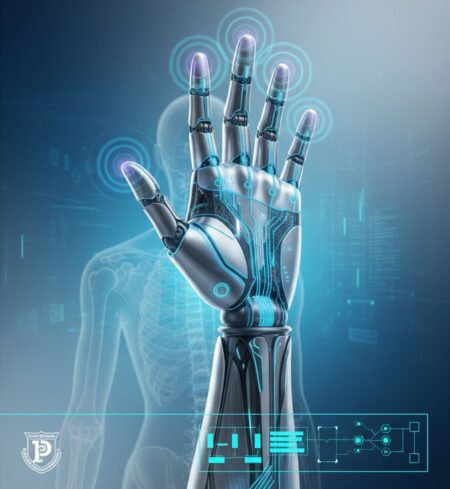
The ALVI Interface represents a significant technological breakthrough in controlling myoelectric transradial prostheses, combining artificial intelligence (AI), surface electromyography (sEMG), and virtual reality (VR). This system allows highly precise hand movements, with up to 20 degrees of freedom, surpassing conventional prosthetic systems.
ALVI System Operation
At the core of the system is HandFormer, a transformer-based encoder-decoder model. HandFormer maps muscle signals to fine finger movements, generating real-time commands for prosthesis control. The AI-sEMG combination dynamically decodes user movement intentions, adapting to individual variations.
Training takes place in virtual reality environments, where amputees practice hand movements using the “hand reflex” method, creating paired sEMG-motion datasets. This approach is critical for users lacking intact limb movements, enabling complete data generation for training the model.
Real-Time Adaptation
A standout feature of ALVI is continuous adaptation. Every 10 seconds, the system updates parameters based on the user’s muscle response and control style. This interactive feedback loop fosters co-learning between user and prosthesis, minimizing recalibration needs and enhancing intuitive control.
Performance and Validation
Clinical tests of ALVI have shown:
- Correlation above 0.8 between predicted and actual movements.
- Response latency below 52 ms.
- Significant improvement in precision and dexterity.
- Fast learning curve for users, easing adaptation.
These metrics position ALVI as one of the most advanced systems for myoelectric prosthetic control worldwide.
Benefits for Patients
- Precise and natural control: up to 20 degrees of freedom.
- Speed and low latency: real-time responsiveness for intuitive manipulation.
- Personalized adaptation: continuous adjustments to muscle conditions.
- Immersive VR training: practice before physical prosthesis, accelerating adaptation.
- Psychological improvement: greater autonomy, confidence, and well-being.
- Neuromuscular rehabilitation potential: aids recovery post-stroke or motor injuries.
Benefits for Professionals
- Advanced customization tool: precise data for tailoring prostheses.
- Reduced calibration time: automatic adaptation optimizes clinical resources.
- Support in rehabilitation: VR-based controlled exercises with objective progress measurement.
- Clinical innovation and competitiveness: positions centers as leaders in advanced rehabilitation.
- Facilitates R&D: collects valuable data to improve algorithms and develop integrated AI-neuroscience solutions.
Future Applications
ALVI not only revolutionizes prosthesis control but also opens opportunities in:
- Advanced neuromuscular rehabilitation: precise functional recovery monitoring.
- Wearable technology integration: exoskeletons and augmentative devices.
- Virtual and augmented reality: immersive training and interactive simulations.
- Neuroscience research: analysis of motor control and learning.
- Automation and co-learning: intelligent systems adjusting responses to users.
Comparison with Other Prosthetic Technologies
| Feature | ALVI Interface | PUCP-Hand | Ottobock Michelangelo |
|---|---|---|---|
| Degrees of freedom | Up to 20 | 5-7 | 5-6 |
| AI adaptation | Real-time continuous | Limited | Partial |
| VR training | Yes, immersive | No | Partial |
| Latency | <52 ms | 70-100 ms | 60-80 ms |
| Customization | High | Medium | Medium |
| Rehabilitation applications | Extensive | Medium | Medium |
ALVI excels in precision, response speed, co-learning, and immersive approach, providing major advantages over conventional prosthetic technologies.
Conclusion
The ALVI Interface sets a new standard in myoelectric prostheses, combining advanced AI, sEMG, and virtual reality for natural, adaptive, and efficient control. Its development not only enhances the quality of life for transradial amputees but also paves the way in rehabilitation, neuroscience research, and human augmentation technologies. The integration of immersive training, low latency, and personalized adaptation makes ALVI a revolutionary tool representing the future of smart prosthetics.