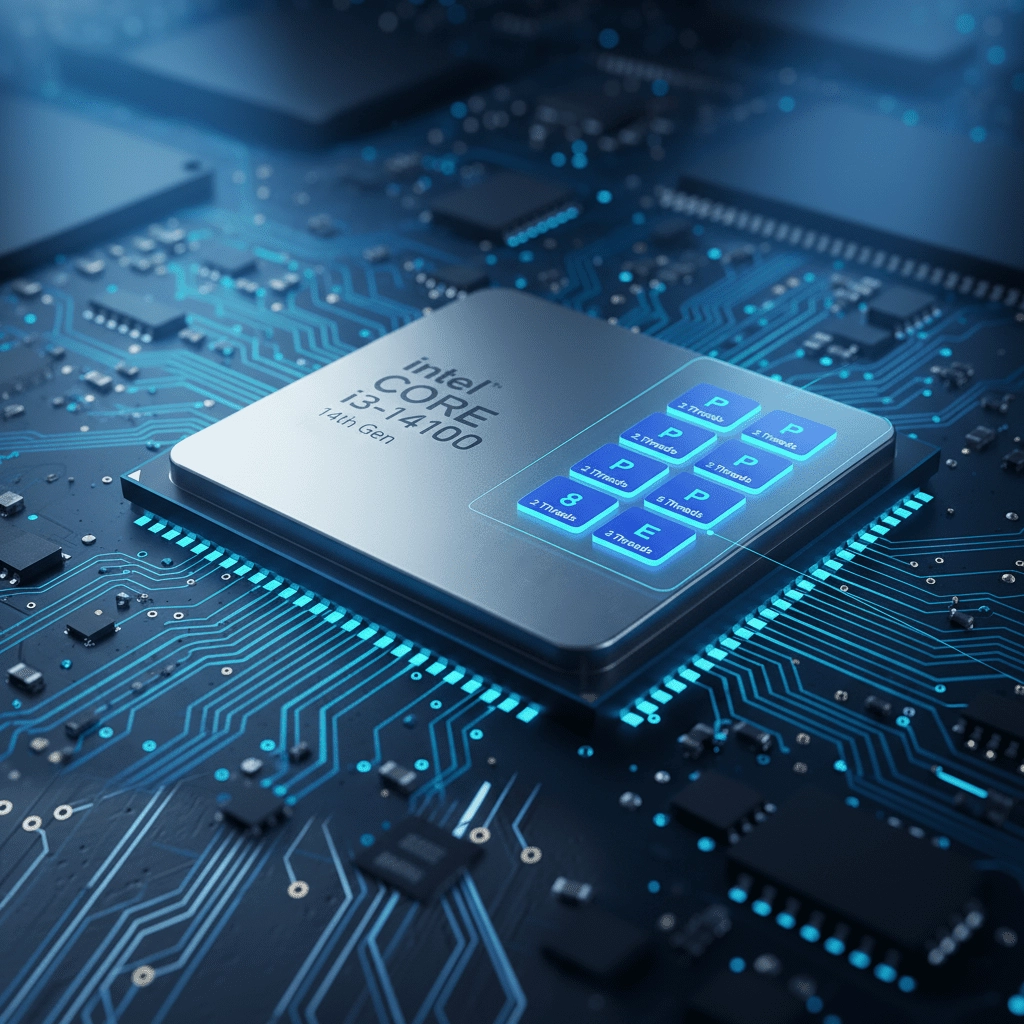
The Intel Core i3 is one of the most influential entry- and mid-range processors from Intel, designed for energy efficiency, solid performance, and affordability. Since its debut in 2010, the i3 line has continuously evolved, integrating new architectures, increasing core counts, and adopting modern technologies that enhance the user experience for both desktops and laptops.
Traditionally, the i3 has been the gateway into the Intel Core family, ideal for home users, students, and professionals who do not require the extreme performance of an i5, i7, or i9, but still expect smooth multitasking, web browsing, office applications, and digital entertainment.
Early Generations: Nehalem and Clarkdale
The first Intel Core i3 processors arrived with the Nehalem and Clarkdale architectures, built on a 45 nm process. They were dual-core processors with Hyper-Threading, meaning each core could handle two simultaneous threads. This feature provided adequate performance for everyday tasks such as web browsing, office suites, media playback, and light applications.
Early i3s also featured integrated Intel HD graphics, delivering basic video solutions without a dedicated GPU, establishing themselves as the ideal choice for compact, low-power systems.
8th Generation: Coffee Lake (2017-2019)
The 8th generation, known as Coffee Lake, introduced a major change for i3 processors. Physical cores increased from two to four, improving multitasking performance and enabling better handling of more demanding applications. While Hyper-Threading was removed in some models, base clock speeds increased and L3 cache size expanded, enhancing overall system responsiveness.
This generation became especially relevant for office PCs, education, and home use, offering an ideal balance between power consumption and sufficient performance for daily tasks.
10th Generation: Comet Lake and Ice Lake (2019-2020)
The 10th generation included two major architectures:
- Comet Lake (14 nm): Maintained efficiency and platform compatibility, focusing on improved clock speeds and general application performance.
- Ice Lake (10 nm): Introduced new core design and upgraded GPU, significantly improving graphics performance, energy efficiency, and capacity for more demanding applications, particularly in laptops and ultrabooks.
Ice Lake made i3 processors more versatile, supporting light gaming, basic video editing, and moderate 3D graphics, bringing user experience closer to mid-range CPUs.
12th Generation: Alder Lake (2021)
With Alder Lake, Intel implemented a hybrid architecture combining Performance Cores and Efficient Cores. For the i3 line, this meant:
- Better responsiveness for mixed workloads.
- Enhanced energy efficiency and light-to-moderate multitasking.
- Support for DDR5 memory and PCIe 5.0, expanding bandwidth and compatibility with modern technologies.
Alder Lake positioned i3 as a competitive option for laptops and compact PCs, providing sufficient performance for hybrid work, education, and multimedia use.
14th Generation: Raptor Lake Refresh (2023)
The latest Raptor Lake Refresh generation refines Alder Lake achievements. Current i3 processors focus on:
- Optimized clock speeds to improve responsiveness in applications and casual gaming.
- Increased energy efficiency for low consumption during continuous tasks.
- Faster and larger cache integration, accelerating program execution and multitasking.
- Support for modern platforms, ensuring compatibility with DDR5, PCIe 5.0, and NVMe storage.
Raptor Lake Refresh proves that i3 remains relevant, adapting to modern computing needs while preserving the low power consumption characteristic of this line.
i3 Generation Comparison
| Generation | Architecture | Cores/Threads | Clock | Integrated GPU | Supported DDR |
|---|---|---|---|---|---|
| 1st-2nd | Nehalem/Clarkdale | 2/4 | 2.13-3.33 GHz | Intel HD | DDR3 |
| 8th | Coffee Lake | 4/4 | 3.6-4.2 GHz | Intel UHD 620 | DDR4 |
| 10th | Comet Lake/Ice Lake | 4/4 | 1.1-4.1 GHz | Intel Iris Plus | DDR4/DDR5 |
| 12th | Alder Lake | 4/8 | 3.0-4.2 GHz | Intel UHD 730 | DDR5 |
| 14th | Raptor Lake Refresh | 4/8 | 3.2-4.5 GHz | Intel UHD 770 | DDR5 |
This table illustrates how Intel has increased cores, improved energy efficiency, and enhanced graphics capabilities over more than a decade, maintaining the Core i3 as a viable and cost-effective option.
The Intel Core i3 has shown consistent evolution from its origins to the 14th generation. The i3 line combines energy efficiency, solid performance, and affordability, adapting to technological changes while remaining relevant in home, educational, and professional environments. From Nehalem to Raptor Lake Refresh, Intel has delivered a reliable platform for users seeking a balance between cost, consumption, and performance.
i3 continues to be a strategic choice for office PCs, student laptops, and computing enthusiasts seeking functionality without complexity, demonstrating that even entry-level processors can offer innovation and quality over time.