
Myoelectric Prosthesis with Haptic Feedback
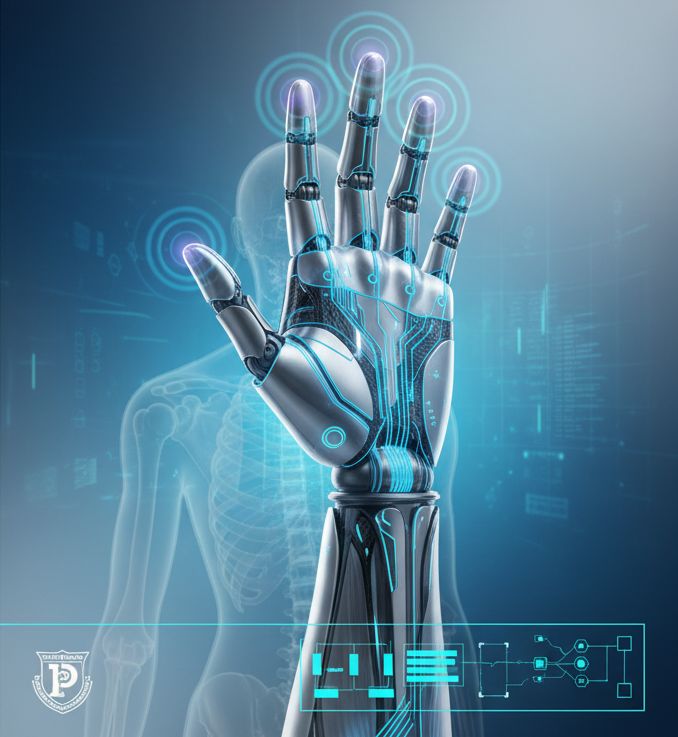
The PUCP-Hand is a transradial myoelectric prosthesis system developed by the Pontifical Catholic University of Peru (PUCP), featuring palmar-digital haptic feedback to improve tactile perception for upper-limb amputees. This innovation allows users to feel critical sensory information, such as finger force, slippage, and position, providing a natural touch experience.
Background and Needs
Conventional prostheses lack direct sensory feedback, limiting fine motor control and dexterity. Many users abandon devices due to frustration and imprecision. PUCP-Hand addresses these limitations by integrating force and position sensors, translating signals into differentiated haptic vibrations on the forearm.
System Components
PUCP-Hand consists of two main subsystems:
- Sensing Subsystem:
- Measures finger flexion and applied force.
- Detects object slippage.
- Captures real-time data to inform the user.
- Actuation Subsystem:
- Generates variable-intensity vibrations on the forearm.
- Three coded vibration types indicate force, slippage, and finger position.
- Enhances precision in handling everyday objects.
Technical Operation
EMG sensors on the residual limb detect electrical impulses generated by muscles. Algorithms interpret the intended movement and applied force, sending signals to haptic actuators. Haptic feedback allows users to adjust grip strength in real-time, achieving more natural and safe movements.
Clinical and Functional Benefits
- Improves user proprioception.
- Increases precision in grip and manipulation tasks.
- Reduces likelihood of device abandonment.
- Enhances confidence and autonomy.
- Provides a near natural human touch experience.
Validation and Testing
The PUCP-Hand system has been validated through:
- Electronic simulations to evaluate actuator response.
- Structural analysis ensuring durability and ergonomics.
- User testing to assess haptic feedback effectiveness and manual dexterity improvements.
Future Applications
PUCP-Hand paves the way for more intuitive smart prostheses capable of:
- Adapting to various object types.
- Integrating real-time haptic feedback with machine learning.
- Connecting to remote or mobile control systems.
- Incorporating advanced sensory feedback, including pressure, temperature, and texture.
Comparison with Other Myoelectric Prostheses
| Feature | PUCP-Hand | Ottobock Michelangelo | Open Bionics Hero Arm |
|---|---|---|---|
| Haptic feedback | Yes, palmar-digital | Yes, limited | Yes, basic |
| Adaptive algorithm | Personalized learning | Partial | No |
| Approximate cost | Low/Medium | High | Medium |
| Materials | Lightweight, durable | Advanced, robust | 3D-printed plastics |
| Customization | High | Medium | Medium |
PUCP-Hand combines efficiency, accessibility, and advanced technology, providing a fuller user experience than many commercial prostheses.
Conclusion
The PUCP-Hand transradial haptic feedback prosthesis represents a technological and functional leap in myoelectric prostheses. It significantly improves dexterity, autonomy, and tactile perception, democratizing access to high-quality smart prosthetics. Its development marks a milestone in robotic rehabilitation and biomedical mechatronics, setting the stage for future innovations in advanced sensory prostheses.